Leadership Insights
Replacing Creative Chaos with Operational Intelligence
AI-Assisted Creative Intake & Prioritization Engine
Designing an AI-assisted intake and prioritization system to reduce operational friction, improve visibility, and help creative teams spend more time creating and less time managing.
Role
Creative Operations Strategy
Focus
AI Workflow Design / Intake Systems / Operational Visibility
Tools Explored
ChatGPT, Notion AI, ClickUp, Slack Automations, Zapier, Structured Prompt Systems
Scope
Design, Prototype, Workflow Integration, Operational Testing
Timeline
Prototype & Iteration: 8 Weeks
01 Context
As creative organizations scale, operational complexity compounds quickly.
Requests arrive through Slack messages, meetings, email threads, spreadsheets, and side conversations. Priorities shift daily. Teams lose time clarifying incomplete requests, manually routing work, and managing escalation cycles instead of focusing on creative execution.
Most intake systems solve documentation but very few solve operational clarity.
I began exploring how AI could function not as a content-generation tool, but as operational infrastructure inside a modern creative organization.
My goal was simple: Reduce “work about work.”
02 Common Intake Pain Points


Incomplete
briefs
Constant clarification cycles


Duplicate or conflicting requests
Manual project routing


Escalation-driven prioritization
Low visibility into capacity


Reactive resource planning
Intake process becomes a bottleneck
Traditional workflows rely heavily on project managers manually interpreting requests, filling operational gaps, and continuously reprioritizing work.
This creates hidden operational drag that compounds as organizations grow.
In many environments, the intake process itself becomes a bottleneck.
03 Operational Insight
Most organizations focus AI experimentation on content generation.
I became more interested in operational orchestration.
The opportunity wasn’t simply generating more creative.
It was improving:
- Decision clarity
- Workflow structure
- Prioritization consistency
- Operational visibility
- Throughput predictability
The question became:
What if AI could function as the first operational layer inside the intake process itself?
04 System Design & AI Workflow Layer
I designed a prototype workflow intended to assist creative operations teams during the intake and prioritization phase.
1. Intake Sources

Slack


Intake Form

Meeting Notes

Campaign Brief

Other Channels
2. AI Intake Layer
(Intelligent Processing)

Categorizes Request

Estimates Complexity

Suggests Priority Tier
Flags Risks / Conflicts

Detects Duplicates

Drafts Clarifying Questions
AI-Enabled
3. Prioritization engine
(Operational Logic)

Business Impact

Timeline Urgency

Stakeholder Scope
Capacity Availability
Strategic Alignment
4. Routing & Workflow
(Automated)

Route to Workstream
Assign Owner
Create Project
Set Priority / SLA

Add to Dashboard
5. Operational Outputs
(Visibility & Action)

Intake Queue
Capacity View
Risk Alerts

SLA Status

Reporting
Add a Feedback Loop for Continuous Improvement
Rather than replacing human judgment, the system was designed to support operational clarity and decision-making at scale.
05 Operational Outcomes
Prototype testing and workflow simulations suggested meaningful operational improvements.

40%
Reduction in clarification cycles
35%
Faster project triage

28%
Improvement in prioritization consistency

25%
Increase in workload visibility accuracy

Sig.
Reduction in manual triage overhead
More importantly, the workflow demonstrated how AI could help creative teams scale operational judgment without introducing additional process complexity.
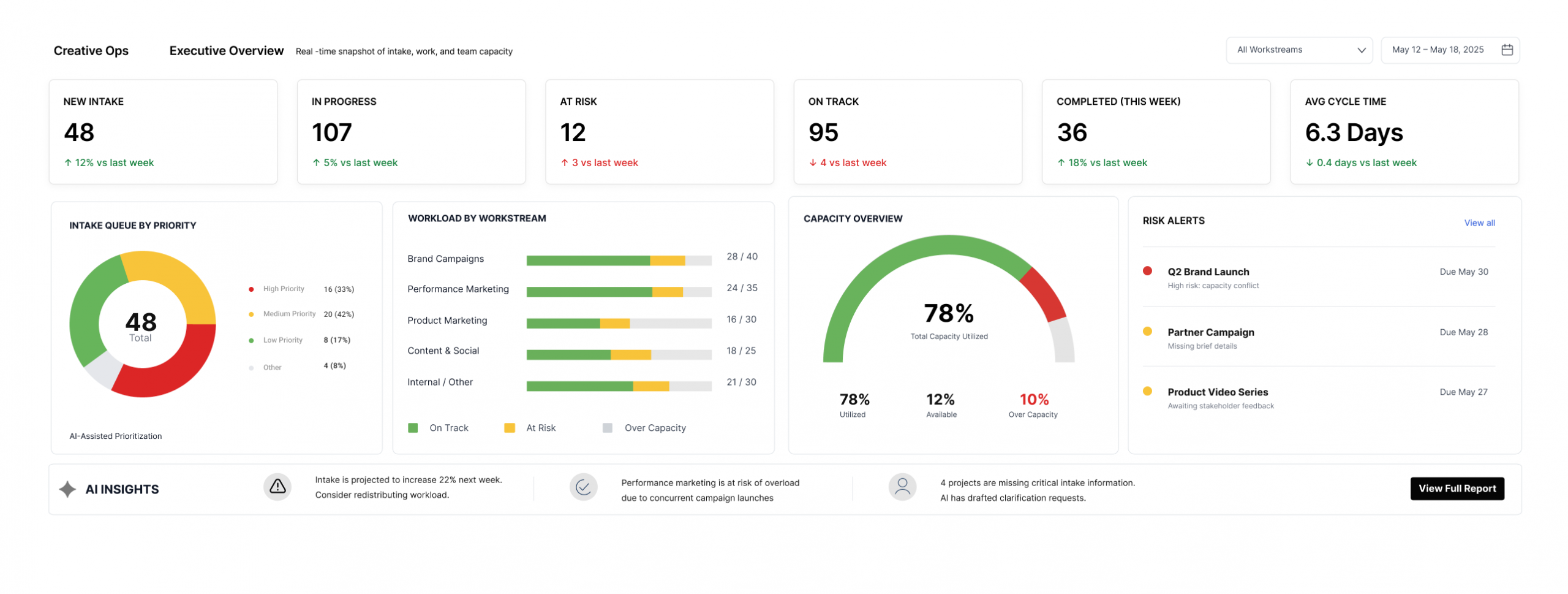
Executive Operations Dashboard Mockup
Real-time visibility into intake, workload, and delivery health empowers better decisions and proactive planning.
Prototype simulation results
06 What I learned
The most valuable application of AI inside creative organizations may not be content generation but operational infrastructure.
Creative teams rarely fail because of a lack of talent.
They fail because operational complexity eventually overwhelms clarity.
AI becomes most valuable when it helps:
- Reduce friction
- Improve alignment
- Surface risk earlier
- Strengthen decision-making
- Protect creative focus
The future of creative operations is not simply faster production.
It’s intelligent operational systems designed to help creative organizations scale clarity, judgment, and execution simultaneously.
I'm always interested in connecting with organizations and leaders who value creativity, clarity, and impact.
I'm interested in opportunities to lead creative organizations where brand, people, and business strategy intersect. Whether building a team, strengthening a brand, or helping an organization navigate growth and change, I'm energized by creating environments where creativity becomes a competitive advantage.
Copyright © 2026 WILLIAM WILBANKS. All rights reserved.